Tech bau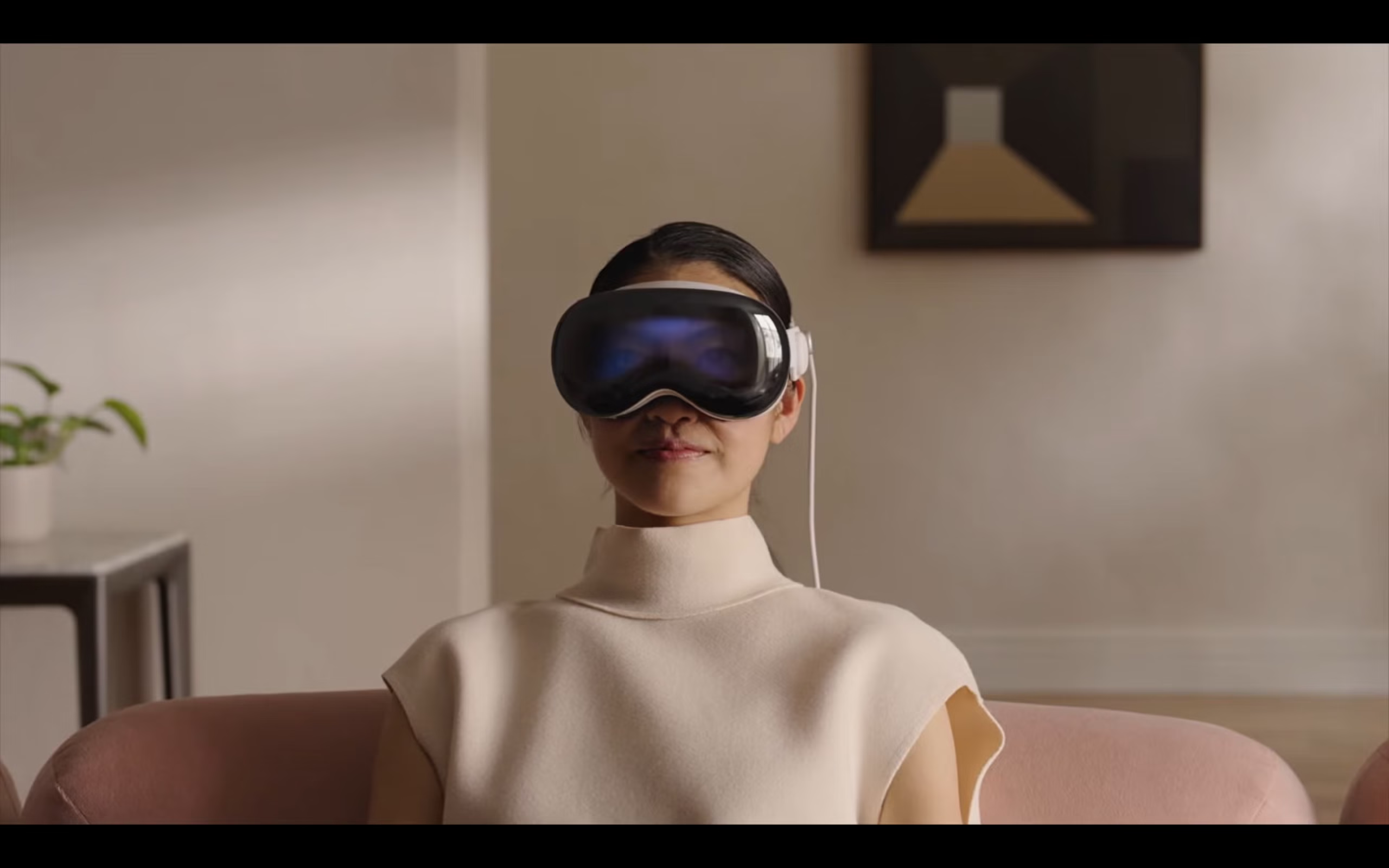
Apple has officially announced that its groundbreaking headset, the Vision Pro, will soon integrate Apple Intelligence, the company’s new generative AI platform. This marks one of Apple’s biggest steps yet toward blending artificial intelligence with spatial computing.
The update, expected to arrive through visionOS 2.4, brings features like Writing Tools, Image Playground, Genmoji, and smarter on-device assistance into the Vision Pro’s immersive world.
The announcement signals more than just a software upgrade—it’s Apple showing that its mixed-reality ecosystem will evolve into a true intelligent computing environment. For users, it means that productivity, creativity, and personalization are about to become far more intuitive inside the headset.
For Apple, it’s a strategic move to unify its hardware lineup under one AI framework and strengthen its position in the global race for everyday, privacy-conscious artificial intelligence.
A New Era for the Vision Pro
When Apple launched the Vision Pro in early 2024, the device was marketed as a “spatial computer”—a headset capable of blending digital elements into real-world spaces. It was an impressive leap forward for mixed reality, but many users and critics felt that the experience lacked one key ingredient: intelligence.
The system could display, render, and track brilliantly, but it didn’t feel as smart or responsive as Apple’s other devices equipped with Siri and iCloud-driven personalization.
That’s now changing. With Apple Intelligence, the Vision Pro becomes not just immersive, but intelligent. The new integration allows the headset to understand context, generate ideas, summarize information, and even create images or emojis from natural-language prompts.
For the first time, Apple’s spatial operating system will include a truly cognitive layer—a virtual assistant that can see, hear, and understand your environment and intent.
What’s Coming to Vision Pro
The Vision Pro’s new update introduces several flagship Apple Intelligence features:
- Writing Tools – These tools let users rewrite, proofread, and summarize text within any supported app. Whether composing an email, taking notes, or editing a document floating in your 3D workspace, the headset can suggest improvements in tone, clarity, and structure. It’s like having an invisible editor who understands what you mean and helps you say it better.
- Image Playground – This creative tool generates visuals from text prompts. Inside Vision Pro, it becomes even more powerful, letting users imagine objects, places, or concepts and watch them materialize as images or 3D scenes. For designers, storytellers, and educators, it turns imagination directly into visual form—no separate screen required.
- Genmoji – Apple’s personalized emoji generator comes to spatial computing. Users can describe a feeling or idea (“make an emoji of a cat drinking coffee on the moon”), and the system instantly creates it. It may sound playful, but it highlights Apple’s push to make AI both fun and user-friendly rather than intimidating.
- On-Device Intelligence – A core principle of Apple’s AI approach is privacy. Most processing happens directly on the headset’s chip, ensuring that personal data stays local. When cloud processing is needed, Apple routes requests through its Private Cloud Compute infrastructure, which does not store or share user information.
- Enhanced Spatial Features – The update will also bring new immersive apps such as Spatial Gallery, redesigned memory viewing for photos and videos, and smarter multitasking powered by contextual understanding.
Why It Matters
This update is important for several reasons. First, it finally gives the Vision Pro a sense of personality and responsiveness that earlier versions lacked. The headset will no longer feel like a passive display of windows floating in space—it will actively help users write, think, and create.
Second, Apple Intelligence on Vision Pro unites Apple’s ecosystem under one smart layer. The same generative tools appearing on iPhone, iPad, and Mac will now exist inside the headset. This means a note drafted on Vision Pro can be summarized with the same AI engine that rewrites an email on your MacBook. It’s Apple’s quiet but powerful way of building consistency across its entire product line.
Third, this launch marks Apple’s entry into what many call “spatial AI”—the intersection of artificial intelligence and mixed reality. Other tech giants have announced similar ambitions, but Apple’s execution tends to focus on user experience, privacy, and design polish. By embedding AI into an already premium device, Apple is showing how intelligence can feel seamless rather than experimental.
The User Experience: Everyday Scenarios
Imagine sitting in your living room wearing the Vision Pro. Floating around you are your email app, a web browser, a photo album, and a document you’re editing. You select a paragraph and ask, “Can you make this sound more professional?” Instantly, the headset rewrites the text, offering a refined version. You nod, and it replaces the original paragraph automatically.
Later, you open Image Playground and say, “Create a futuristic office with transparent walls and sunlight coming through.” Within seconds, a vivid 3D image forms in front of you. You can look around it, zoom in, or even save it as a background scene.
Before ending your session, you get a message from a friend. You reply with a custom Genmoji—a cartoon version of both of you celebrating with confetti—generated instantly from your voice description. None of it required typing or leaving your spatial workspace.
This is the kind of integrated creativity and convenience Apple Intelligence brings to Vision Pro. It takes familiar interactions and makes them fluid, conversational, and personal.
Apple’s Strategic Shift
Apple’s integration of AI into the Vision Pro isn’t just a technical upgrade—it’s a strategic move in a global competition for AI relevance. While companies like Google, Microsoft, and Meta push AI through cloud-based chatbots and productivity tools, Apple is doubling down on on-device intelligence.
The company’s philosophy is clear: AI should help users without exploiting their data. Apple Intelligence processes as much as possible locally, keeping user prompts, texts, and files private. When tasks require cloud power, they go through encrypted servers that forget everything once the task ends. For users concerned about privacy, that’s a major reassurance.
Bringing this system into Vision Pro also future-proofs Apple’s most ambitious product. The headset launched to mixed commercial success—praised for its technology but questioned for its price and practicality.
By adding intelligence, Apple gives the Vision Pro a stronger value proposition: it’s not just an entertainment or design tool; it’s a thinking companion for work, creativity, and communication.
Developers and the Ecosystem
For developers, the arrival of Apple Intelligence in visionOS opens up new opportunities. Apple is providing APIs that allow third-party apps to use Writing Tools, image generation, and natural-language understanding within their own spatial experiences. This means that productivity apps, design tools, educational software, and games can all become smarter.
For example, a 3D design app could let users describe a structure verbally, and the system would generate a draft model. A note-taking app could summarize voice notes into text floating on a virtual whiteboard. A language-learning app could use spatial cues and generative visuals to create immersive lessons on the fly.
As developers begin experimenting with these tools, Apple’s ecosystem could expand rapidly, transforming the Vision Pro into more than just a premium headset—it could become a new category of intelligent computing altogether.
Limitations and Early Rollout
As with most new features, there are limits. Initially, Apple Intelligence will be available only in English (US), and not all features will launch globally right away. Some tools, like writing assistance and image generation, are in beta and may have occasional quirks.
There’s also the issue of hardware cost. The Vision Pro remains one of the most expensive consumer electronics devices, making widespread adoption slow. Even with AI enhancements, the audience will remain niche for now—mainly developers, tech enthusiasts, and professionals in design, engineering, and media.
Still, as Apple refines its hardware and possibly introduces lighter, more affordable versions in the future, these intelligent features could become standard across models. Over time, what starts as a premium experiment may evolve into a mainstream way of computing.
The Broader Impact: Merging AI and Spatial Computing
Apple’s move illustrates a broader industry trend. Artificial intelligence is no longer just about chatbots and text—it’s becoming an invisible layer embedded in every interface.
Spatial computing, on the other hand, is about how we see and interact with digital content around us. Combining the two makes technology feel less mechanical and more human.
The Vision Pro with Apple Intelligence is a clear example of that shift. You no longer “use” a computer in the traditional sense—you interact with it naturally, through sight, sound, and conversation. AI becomes part of your space, anticipating needs and adapting in real time.
In the long run, this could redefine productivity, creativity, and even entertainment. Meetings might involve AI assistants that summarize discussions in real time. Artists could sculpt with words instead of tools. Educators might teach history through AI-generated reenactments that appear in front of students.
Looking Ahead
Apple hasn’t said this explicitly, but the Vision Pro’s integration of Apple Intelligence likely foreshadows the future of all its devices. The same AI layer that powers the headset will continue to evolve across iPhone, iPad, and Mac.
Upcoming versions of Siri will also tie into Apple Intelligence, allowing for more natural and context-aware conversations. In the future, users might move between devices—starting a task in Vision Pro and finishing it on a Mac—without losing continuity, because the same intelligence engine understands what they’re doing.
There’s also potential for new Apple hardware built around intelligence first: lighter headsets, AR glasses, or even voice-based wearables that rely entirely on this AI system.
Conclusion
The integration of Apple Intelligence into the Vision Pro is a milestone moment for both Apple and the broader technology landscape. It transforms the headset from a stunning display of mixed reality into a smart, creative, and personal computing experience.
By merging artificial intelligence with spatial computing, Apple is shaping what the next decade of personal technology could look like—a world where devices don’t just respond to commands, but understand intent, adapt to context, and protect user privacy along the way.
In the end, Apple isn’t simply catching up in the AI race—it’s redefining how intelligence should feel: private, human, and seamlessly integrated into the spaces we live and work in.
The Vision Pro’s evolution proves that the future of computing isn’t just about screens or voice—it’s about intelligent experiences that exist all around us.